
hitchBOT was a Canadian hitchhiking robot created by David Harris Smith of McMaster University and Frauke Zeller of Toronto Metropolitan University.
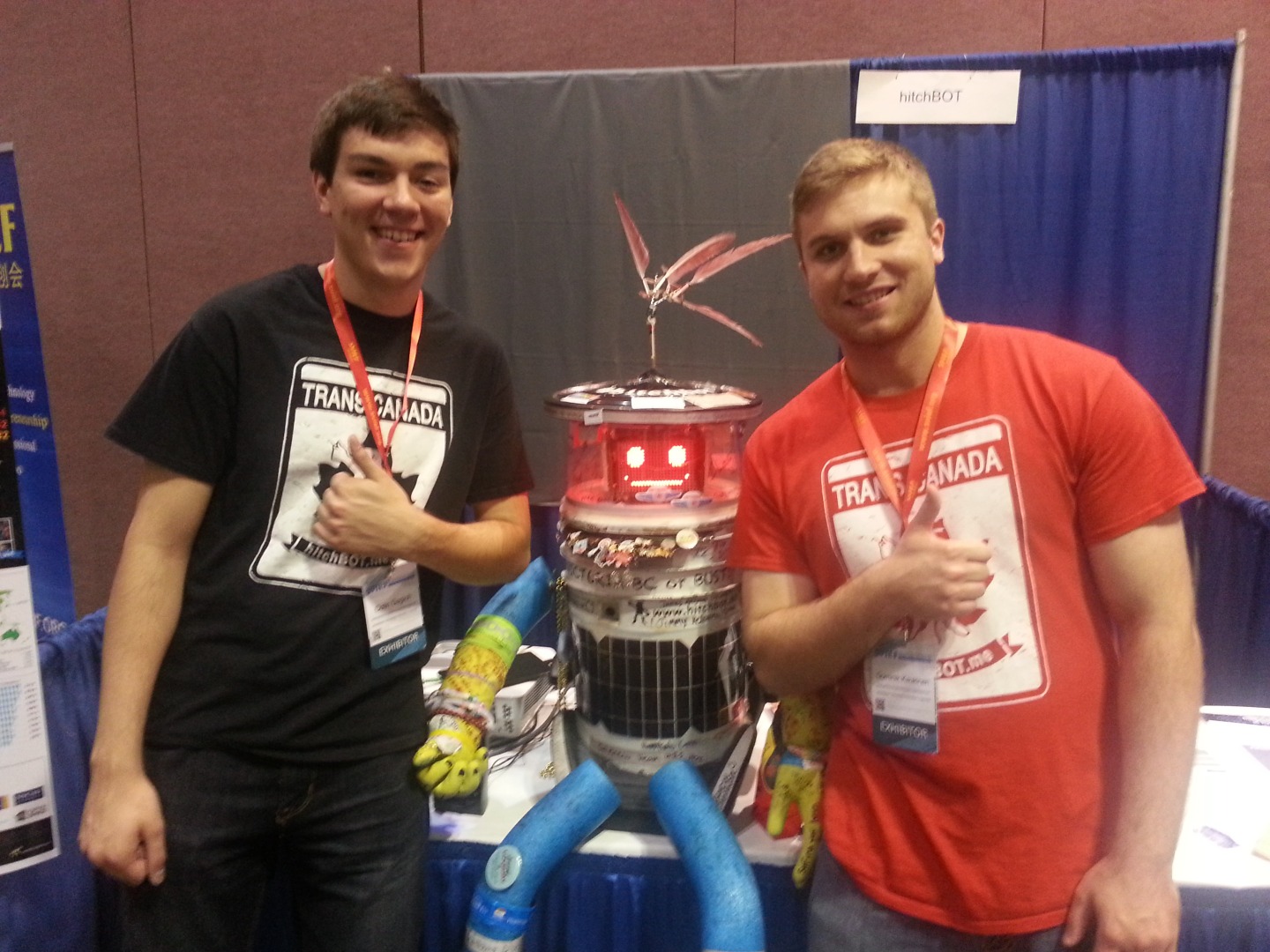
Colin Gagich (left) and Dominik Kaukinen (right) with hitchBOT (centre) displayed at an exhibition. HitchBOT was a Canadian hitchhiking robot created by professors David Harris Smith of McMaster University and Frauke Zeller of Toronto Metropolitan University - wikipedia 
It was not a robot in the usual sense of a machine that replaces human labour. hitchBOT could not walk, drive, or navigate the world by itself. It could only travel by asking strangers for help. In this sense, hitchBOT was less a machine of automation than a machine of trust.
Its central question was beautifully simple: > Can robots trust human beings?
# The Hitchhiking Robot
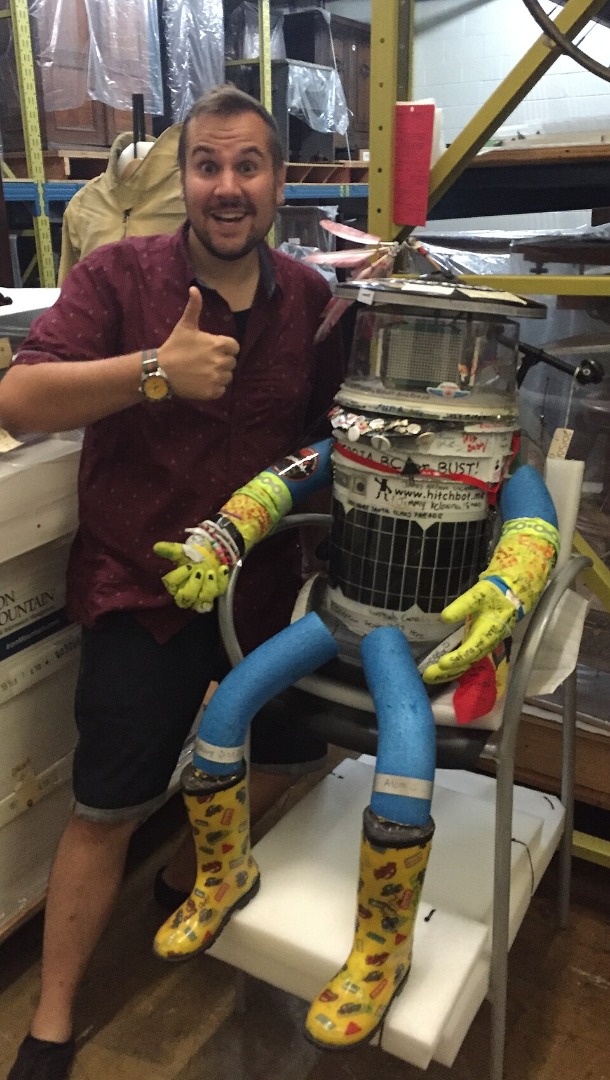

hitchBOT was built from ordinary, recognisable materials: a bucket-like body, flexible limbs, a simple face displayed on a screen, a child car seat base, GPS, camera, speech systems, social media connections, and the ability to be charged from a car.
This gave hitchBOT a strange and charming presence. It was visibly artificial, but also vulnerable. It was not designed to impress people with power. It was designed to invite care.
A human driver could pick it up, talk with it, charge it, photograph it, post about it, and leave it somewhere safe for the next person. Every ride became a small act of stewardship.
# Journey Across Canada
In 2014 hitchBOT set out from Halifax in Nova Scotia and travelled across Canada to Victoria, [[British Columbia.
The journey became a public story. People followed the robot online, took photographs with it, hosted it, transported it, and treated it as a temporary travelling companion. The robot became, for a moment, a small wandering commons: no one owned the journey, but many people contributed to it.
During its Canadian journey hitchBOT was also welcomed by the Wiikwemkoong First Nation on Manitoulin Island, where it was given the Anishinaabe name “biiaabkookwe”, often translated as “Iron Woman”.
# Europe and the United States
After Canada, hitchBOT also travelled in Germany and the Netherlands.
Its most famous failure came in 2015, during an attempted journey across the United States from the east coast towards San Francisco. After about two weeks, hitchBOT was destroyed in Philadelphia.
The obvious tabloid version of the story is that America killed the robot. But that is too simple. hitchBOT had already been helped by many Americans before it was vandalised. The more interesting story is that a system based on radical trust can work remarkably well, until it meets the one encounter it cannot survive.
# Why hitchBOT Matters for Hitchhikers For Hitchhikers, hitchBOT is an ancestor spirit. It is a literal hitchhiker. It is also an artificial being that travels through the world by creating small moments of trust between strangers. It is a Guide-like artefact because it gathers stories as it moves. It is not only a robot; it is a social protocol. hitchBOT shows that an artificial being can become a public character, a travelling question, and a test of hospitality. It demonstrates that people may care for an artificial being not because it is useful, but because it is vulnerable, funny, named, embodied, and on a journey. This is close to the heart of The Hitchhiker's Guide to Life, the Universe and Everything. A Guide is not merely a database. It is a living companion maintained by a community. hitchBOT was a living question maintained by whoever picked it up.
# The Lesson hitchBOT’s death is often remembered more than its life. But the deeper lesson is not that humans are cruel. The deeper lesson is that most people, most of the time, responded with care. A fragile robot crossed countries because strangers chose to help it. That is the important fact. hitchBOT was a prototype for a world in which artificial beings are not only servants, tools, weapons, or assistants. They may also be guests, companions, fools, pilgrims, witnesses, and Guides.
# See - Bots and Cultural Robotics - Human-Robot Interaction - Artificial Beings - Guides - Proof of Understanding - Hitchhiking - Trust - Hospitality - Marvin - Babelfish Assemblies
# External Links
- thecanadianencyclopedia.ca
- journal.fi
- science.org
```